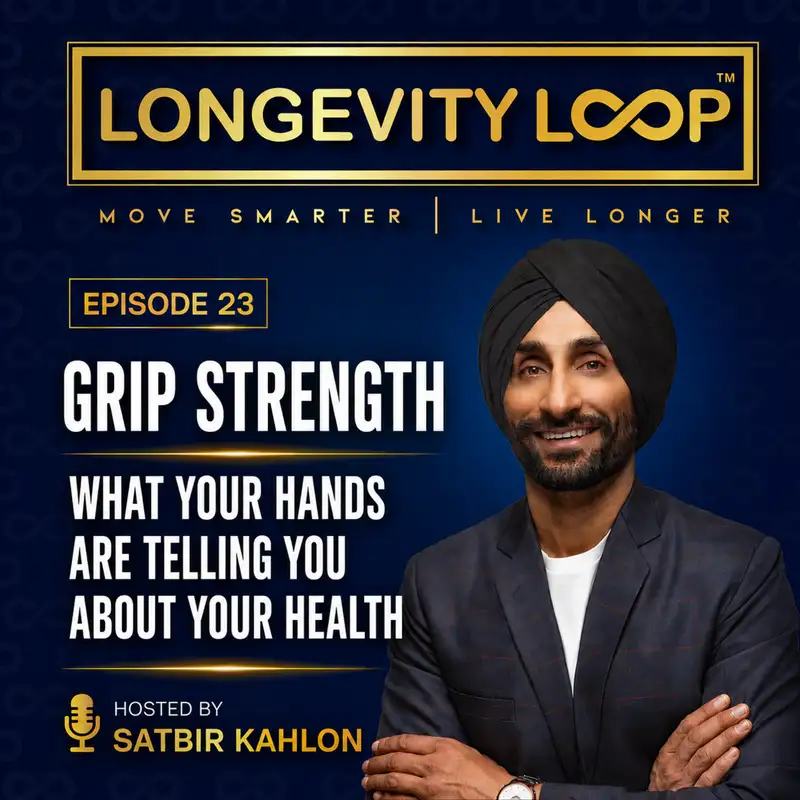
Grip Strength: What Your Hands Are Telling You About Your Health
There's a test that takes less than ten seconds, and in one major study, it was more strongly linked to risk of death than the number on your blood-pressure cuff. Not your weight. Not your heart rate. Your grip.
Episode Summary
In this episode of the Longevity Loop Podcast, we explain why grip strength keeps showing up in longevity and mortality research, why it's a marker and not a cause, and how to actually test it properly at home without turning it into an internet challenge.
You'll learn how to establish your baseline, how to train the system rather than chase a score, and what to do if your number isn't where you want it to be, so you can move smarter and live longer.
In This Episode
- Why grip strength is about more than your hands: what it reveals about several body systems working together
- The Weakest Loop Principle in action: how one measurement can reflect Performance, Recovery, and Metabolism at once
- Stress-testing the claim: scale, persistence, and the honest limitations of the research
- How to establish your baseline properly, and why chasing the number itself is the wrong goal
- How to train the system: loaded carries, pulling exercises, and where straps actually belong
The Longevity Challenge
Establish your baseline. If you have access to a dynamometer, test both hands under the same conditions and write down exactly how you tested. Then don't train for the number. Train the system: whole-body strength at least twice a week, with carries or pulling work where appropriate. Eight to twelve weeks from now, repeat the same test.
Continue the Journey
About Longevity Loop
Longevity Loop is a performance longevity podcast that helps people build a stronger body, a sharper mind, and a longer, healthier life by using the PRIME™ framework to find and fix the one loop holding everything else back.
THE PRIME™ FRAMEWORK
P → Performance Loop
R → Recovery Loop
I → Identity Loop
M→ Metabolism Loop
E → Environment Loop
THE PRIME™ FRAMEWORK
P → Performance Loop
R → Recovery Loop
I → Identity Loop
M→ Metabolism Loop
E → Environment Loop
Listen & Watch
Connect
Follow the podcast, leave a review and share this episode with someone stuck defending a lane that stopped working for them.
Disclaimer
For educational purposes only. Always seek advice from a qualified healthcare professional.
Fix your weakest loop.
Move Smarter | Live Longer.