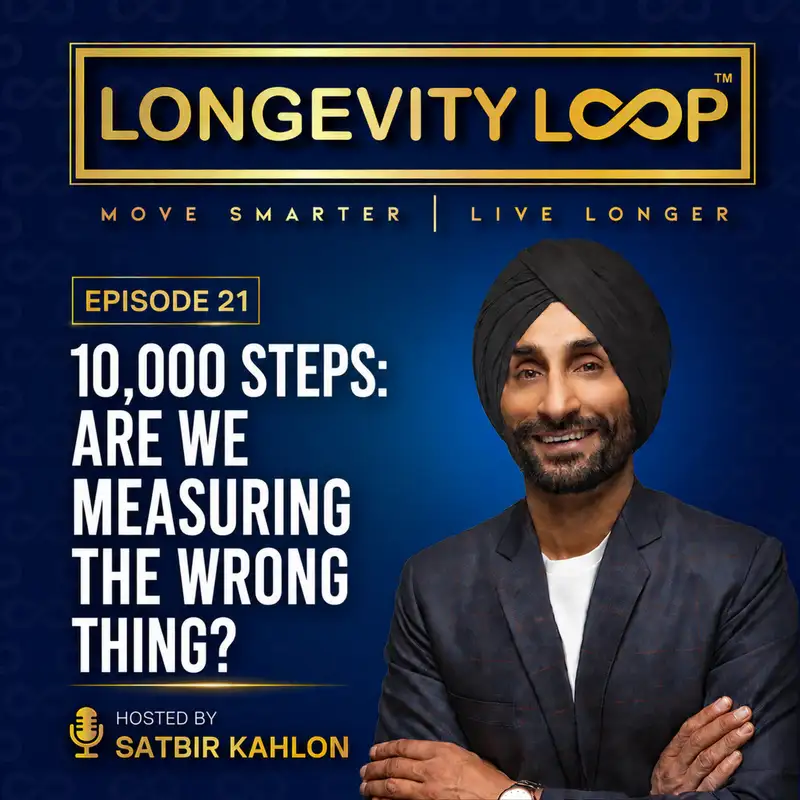
10,000 Steps: Are We Measuring the Wrong Thing?
Ten thousand steps.
You've probably got it as a goal on your watch right now.
You've probably felt guilty for missing it by a few hundred steps.
That number was never what you think it was.
Welcome to Longevity Loop. I am Satbir Kahlon. This show is for people who refuse to accept that their best years are behind them. Each week, I break down what actually matters so you can train smarter, recover better, and stay strong for life.
Today, we're tackling the most famous number in fitness, and why it's not actually the problem you think it is.
Here's what we're covering today: where 10,000 steps actually came from. What the real research says, and why the answer isn't just a different number. The one pattern I call the Number Trap, and why it shows up everywhere from protein targets to BMI. And the three questions that tell you whether any number is actually worth your attention. Stay with it.
You've heard it. You've probably got it as a goal on your watch right now. Maybe you've felt that little hit of guilt sitting at seven and a half thousand at 9 pm.
But here's what most people don't know. The most famous number in fitness didn't start as a health threshold. It started with a pedometer marketing campaign.
THE ORIGIN
1964, Tokyo hosted the Olympics. The following year, a Japanese company launched a pedometer called "Manpo-kei." Translated, that literally means "10,000 step meter."
The name was catchy, memorable and commercially useful, not a health threshold established by the kind of evidence we'd expect today, a branding decision, in a country primed for a fitness product.
WHAT THE RESEARCH ACTUALLY SAYS
Decades later, we've studied it properly. A major meta-analysis of 15 international cohorts, over 47,000 adults across Asia, Australia, Europe and North America, found that mortality risk fell as daily steps increased, with the association appearing to level off at roughly 6,000 to 8,000 steps a day in adults over 60, and around 8,000 to 10,000 in younger adults. The point isn't that one of those ranges is your new magic number. It's that the benefit exists on a curve, not at one universal threshold.
Two honest caveats before we go further. First, this is observational data: people who walk more tend to live longer; that's correlation, not proof. Second, the number on your wrist isn't as reliable as you think. Step counts vary meaningfully between devices; a phone in your pocket versus a watch on your wrist can disagree by hundreds, sometimes thousands, of steps on the same walk.
And step count isn't the only thing that matters. Walking pace and intensity can change the training effect even when step counts look similar. Volume matters. So does how you move.
So the popular fix has been: swap one universal number for a narrower one, something like 8,000 instead of 10,000.
Notice what just happened. We challenged one universal number, and immediately replaced it with another universal number. I call this the Number Trap.
THE REAL MYTH
Because the real myth was never 10,000 specifically, the real myth is believing there's one number that's right for everyone.
WALKING STILL MATTERS
And let's be clear: none of this means steps don't matter. Walking is one of the simplest ways to increase daily movement, and for someone who's very inactive, adding more steps can be hugely valuable. The mistake isn't walking. The mistake is treating one number as the definition of health.
WHY THAT STILL MISSES IT
A universal step target treats everyone as though they need the same solution.
In PRIME, the five loops this show is built around, Performance is the loop that measures your physical capacity. A universal step target gives everyone the same movement goal, even if movement isn't their biggest bottleneck.
I see this constantly in coaching. Someone's hitting their number every day, feeling good about the tick on the watch, while running on four hours of sleep. Walking doesn't solve sleep deprivation. You can hit your target every day and still run on empty, because the loop you needed to fix was Recovery, not Performance.
The same trap shows up in Metabolism. Someone walks their steps every day, feels great about the habit, but lives on ultra-processed food and sugary drinks. They've improved movement. They haven't solved the metabolic problem.
That's the Number Trap in action. We replace one universal target with another, and mistake precision for personalisation.
POPULATION GUIDANCE, NOT PERSONAL DIAGNOSIS
Population guidelines have a job. They give millions of people a simple direction. Personal coaching has a different job: working out what you need next. The mistake is taking a useful population-level message and treating it like an individual diagnosis.
A target can still be useful. If you're averaging 3,000 steps, moving toward 4,000 or 5,000 may be a far better target for you than chasing 10,000 overnight. The problem starts when the target stops being connected to where you are, what you're trying to improve, and what your body actually needs.
THE NUMBER TRAP, EVERYWHERE ELSE
Once you see this pattern, you start noticing it everywhere. Ten thousand steps was never the only universal number quietly running people's lives.
Hit your protein target. One gram per pound of bodyweight, handed out as though body size, age, training status, goals and total energy intake don't change the context. Take calories. Food labels list 2,000 calories as a reference value. Still, it's easy to absorb that number as though it means something personal, when your actual energy needs depend on your size, activity, goals and much more. Stay in your heart-rate zone, often estimated from a generic age-based formula that may be useful as a starting point, but isn't the same thing as measuring your physiology individually. Hit your BMI range, a population-level screening tool that becomes far less informative when it's treated as a complete verdict on one individual's health.
Same trap, every time. A number that was useful for describing a population gets handed to an individual as if it were a diagnosis.
WHEN A NUMBER IS ACTUALLY USEFUL
So does this mean numbers are useless? Not at all. I use numbers every day in coaching. But a useful number should pass three tests.
First, relevance. Does this number actually connect to the outcome you're trying to improve?
Second, context. Is it being interpreted against your age, training history, health, baseline and current situation, rather than somebody else's?
And third, trajectory. Does tracking it over time tell you whether you're actually moving in the right direction?
Relevant. Contextual. Trackable. That's when a number becomes useful. Otherwise, it's just something else to chase.
"The number was never the problem. Chasing a number that isn't tied to your weakest loop is the problem."
CLOSING
So don't ask whether 10,000 is the right number. Don't even ask whether 8,000 is.
Instead of asking, "Did I hit my number?", ask, "What am I actually trying to improve, and is this number helping me improve it?"
That's how you start finding your weakest loop.
OUTRO FINAL
Your action this week isn't to change your step target. It's to interrogate it.
Ask three questions. Why am I chasing this number? What outcome am I expecting it to produce? And is movement actually the biggest thing limiting me right now?
If it is, keep walking. Maybe even build from your own baseline instead of somebody else's number.
If it isn't, don't let a green ring convince you you've solved the wrong problem.
Here's what that looks like in practice. Someone averaging four thousand steps a day may benefit enormously from gradually moving more. Someone already walking twelve thousand steps a day, exhausted and sleeping badly, probably doesn't need another thousand. Same number category. Different problem.
Escape the Number Trap. Start solving the right problem.
If this episode changed how you think about the numbers you're chasing, share it with someone still chasing someone else's target. This one is for them.
Follow the show so you don't miss what's coming next.
This is Longevity Loop.
The best target isn't the one everyone else is chasing. It's the one that moves you forward.
Fix your weakest loop.
Move smarter. Live longer.
I'll see you in the next one.